

Which Of These Is Considered A Rice Cake
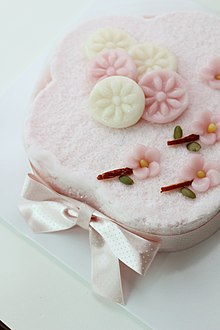
tteok, a course of Korean rice cake
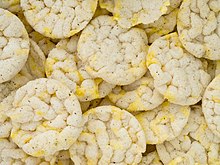
A rice cake may be any kind of food item made from rice that has been shaped, condensed, or otherwise combined into a single object. A wide diversity of rice cakes exist in many different cultures in which rice is eaten and are particularly prevalent in Asia. Mutual variations include cakes made with rice flour, those made from ground rice, and those made from whole grains of rice compressed together or combined with some other bounden substance.
Types of rice cakes by region [edit]
Types of rice cake include:
Burmese [edit]
Burmese cuisine has a variety of snacks and desserts called mont made with various types of rice, rice flour and viscid rice flour. Sweet Burmese mont are generally less sweetness than counterparts in other parts of Southeast Asia, instead deriving their natural sweetness from elective ingredients (e.thousand., grated coconut, coconut milk, glutinous rice, etc.).[1] [2]
Cambodian [edit]
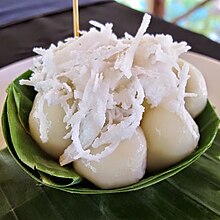
Num Plae Ai (ផ្លែអាយ) Khmer sticky rice assurance with coconut topping
- Ansom chek is a assistant leaf sticky rice cake. It is served all year long simply it is most prevalent during Bun Pchum Ben or "Ancestors' Twenty-four hours" festival. It is served either with a banana filling or pork fat strips and beans then they are wrapped with layers of assistant foliage and steamed to perfection and then served.[3]
- Num Kom is steamed sweet sticky rice flour block filled with palm sugar, freshly grated kokosnoot and roasted sesame seeds. It is traditionally made and eaten on Memorial day for ancestors (Bun Pchum ben/Don-ta), Visak (Buddha birthday) and especially Cambodian New Year ( Bon chol thnam tmey ). It takes the shape of a pyramid to represent Buddhist pagoda towers.[iv] [5]
- Num Krok is sticky rice cake that is mixture of rice flour, coconut milk, chopped shallots and a little salt, dipped in fish and chili sauce and sometimes palm sugar. It is made with an fe pan.[half-dozen] [7]
- Num Plae Ai(ផ្លែអាយ) is sticky rice balls with palm sugar on the inside and rolled in fresh coconut for a beautiful cover.[8] [9] [10]
- Num Ah-Kor (នំអាកោរ) is one of the most popular Cambodian/Khmer dessert. It is a dessert that is served during Khmer New Year and festivities. It is made with rice flour and topped with fresh shaved coconut. It comes in many colors.[11]
- Nom Chak-Kachan also known as gummy rice layer cake. It is fabricated with gluey rice, tapioca flours, and coconut milk. It comes in a number of colors with green and yellow layers being the nigh popular.[12] [thirteen]
Chinese [edit]
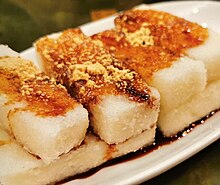
Ciba block with Brown Sugar and roasted soybean flour
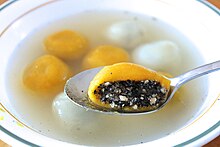
Pumpkin Tangyuan with red bean paste and black sesame fillings
- Chongyang block is a steamed rice flour block, with edible bean or bean paste as inner layer, decorated with jujube, chestnuts, almonds, and osmanthus. It is specially made for Chongyang Festival.
- Ciba cake is made by glutinous rice pounded into paste, often molded into shapes of balls or cuboids, and unremarkably dipped into chocolate-brown sugar syrup and roasted soybean flour after being fried or steamed.
- Erkuai (lit. 'ear slice'), a reference to the shape of 1 of its mutual forms. Erkuai is generally stir-fried or grilled and rolled effectually a youtiao.
- Fa gao is a steamed cupcake-similar pastry, nigh commonly consumed on the Chinese new year. It is made of rice flour, leavening (traditionally yeast), sugar.
- Jian dui (aka Ma tuan, or Sesame Ball) are a type of crisp and chewy hollow glutinous rice pastry often filled with red bean and coated with sesame on the outside
- Funing big block is fabricated with glutinous rice flour and various nuts as garnishes. Information technology is molded into cuboid shape, steamed, and so sliced to newspaper-like pieces.
- Ludagun (aka Ass Roll) is a traditional Manchu snack in Prc. It is a round sticky rice pastry with honey and crimson bean paste filling, rolled with yellow soybean flour dusted over.
- Nuomici is glutinous rice ball, filled with a sweet filling with dried coconut flakes dusted on the outside.
- Mi gao (米糕, rice cake), Nuo mi gao (糯米糕, gummy rice block), or Jiang mi gao (江米糕, river rice cake), is a cake that directly fabricated with glutinous rice, added dates or longan pulp or cerise bean, steamed thoroughly, and cut to pieces or blocks.[14]
- Zèng gao (甑糕, caldron cake), called as Jing gao in Shaanxi dialect, is a rice cake steamed originally with an aboriginal Chinese food vessel Zèng(甑), and now people use steamer to melt information technology. It is layered repeatedly with mucilaginous rice, scarlet edible bean, glutinous rice, dates and raisin. Information technology is like to Mi gao, yet originate from different regions and cooked by different cookware.[15]
- Nian gao includes many varieties, all fabricated from glutinous rice that is pounded or basis into a paste and, depending on the variety, may simply be molded into shape or cooked again to settle the ingredient.
- Osmanthus cake is a traditional sweet-scented Chinese pastry made with pasty rice flour, honey sweetness-scented osmanthus and rock sugar.[xvi]
- Qingtuan is fabricated of mucilaginous rice mixed with Chinese mugwort or barley grass juice, resulting in green colour, ordinarily filled with sweet red or black bean paste. It is a seasonal snack, and especially made for the Qingming Festival.
- Song gao is a Shanghai snack equanimous of rice flour, sugar, and water, with azuki beans embedded throughout the cake.
- Tangyuan is made by mixing glutinous rice flour with a pocket-sized amount of water to course balls and is and then cooked and served in boiling water.
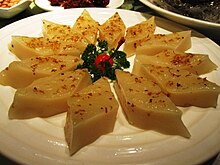
- White sugar sponge cake is a steamed rice block that is typically consumed in square pieces or triangles.
Filipino [edit]

Puto, a traditional Filipino steamed rice block
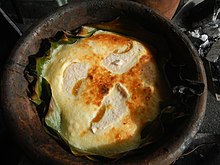
Bibingka, a traditional Filipino rice cake baked in a clay pot
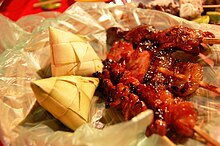
Filipino puso rice cakes, made from mucilaginous rice cooked in woven pouches of various designs, are eaten with savory dishes
Rice cakes are a common snack in the Philippines and Filipinos take created many dissimilar kinds. In Filipino, desserts (mostly rice-derived ones) are known every bit kakanin , derived from the give-and-take kanin, meaning "prepared rice." Rice cakes were besides formerly known by the general term tinapay (lit. 'fermented with tapay '), merely that term is at present restricted to mean "bread" in modern Filipino.[17] Nevertheless, two full general categories of rice cakes remain: puto for steamed rice cakes, and bibingka for baked rice cakes. Both are usually prepared using galapong, a viscous rice paste derived from grinding uncooked mucilaginous rice that has been soaked overnight. Galapong is normally fermented, as the erstwhile term tinapay implies.[18]
Some examples of traditional Filipino dessert rice cakes include:
- Ampaw is a Filipino sweet puffed rice block. It is traditionally made with lord's day-dried leftover cooked white rice that is fried and coated with syrup.
- Baye baye is a type of rice cake fabricated from coconut and footing light-green rice (pinipig) or basis corn kernels
- Bibingka is a blazon of rice cake made with galapong and coconut milk or water, with its bottom lined with banana leaves. It is traditionally baked using specially made clay ovens and preheated charcoal.
- Biko, also called sinukmani or wadjit, is a type of rice cake made from coconut milk, carbohydrate, and whole glutinous rice grains
- Espasol is made from rice flour cooked in coconut milk and sweetened kokosnoot strips, dusted with toasted rice flour
- Kutsinta is a steamed rice block (puto) made with rice flour, dark-brown sugar, lye, and freshly grated mature coconut meat
- Mache (as well spelled matse) are boiled mucilaginous rice balls flavored with pandan and coconut
- Masi are boiled or steamed glutinous rice balls with a peanut and muscovado filling
- Moche (also spelled mochi or muchi) are boiled gummy rice balls with bean paste fillings served with hot sweetened coconut milk
- Palitaw is a boiled rice block deejay covered with freshly grated mature coconut meat and sugar
- Panyalam is like to bibingka but is fried instead of baked. It is popular amidst Muslim Filipinos and the Lumad people of Mindanao.
- Puto is a full general term for steamed rice cakes popular all over the country with numerous variations
- Puto bumbong is a steamed rice cake (puto) cooked in bamboo tubes and characteristically deep purple in colour
- Salukara is similar to bibingka but is cooked every bit a large flat pancake traditionally greased with pork lard
- Sapin-sapin is made from viscous rice flour, coconut milk, carbohydrate, h2o, and coconut flakes sprinkled on top. Its distinguishing layered appearance is achieved by using food coloring
- Suman is fabricated from glutinous rice cooked in coconut milk, and oftentimes steamed in banana leaves
- Tupig, a rice cake fabricated from galapong, coconut milk, sugar, and young kokosnoot wrapped in assistant leaves and baked directly on charcoals
Some of these rice cakes tin can be considered savory. Putong bigas, the most common type of puto, for instance, is traditionally paired with the savory pig'southward blood stew dinuguan. Bibingka galapong tin likewise be topped with meat or eggs. Bated from these, non-dessert rice cakes eaten as accompaniment to savory meals also exist, the nearly widespread being the puso.
- Binalot is a generic term for rice with various accompanying dishes wrapped in assistant leaves
- Kiping is a thin wafer-like rice cakes uniquely molded from real leaves. Usually eaten dipped with vinegar, but can exist eaten as a dessert with sugar.
- Pastil is a packed rice dish with shredded beef, craven, or fish wrapped in banana leaves
- Puso is a widespread class of rice cakes made from gummy rice cooked within woven pouches of various designs. These are differentiated from other non-dessert rice rice cakes wrapped in leaves, in that the leaves in puso are woven into complex designs, not simply wrapped effectually the rice cakes.
Indian [edit]

Idli, a due south Indian savory cake
- Patoleo are sweetness rice cakes steamed in turmeric leaves consisting of a filling of coconut and palm jaggery. These are prepared by the Konkani people during their festivities.[19]
- Pitha, in the Bengali, Assamese and Oriya cuisines, is commonly a sparse-flat cake prepared from a concoction made with soaked and basis rice. They are ordinarily cooked on a hot griddle or frying pan and could exist fried in oil, roasted over a slow burn or baked and rolled over a hot plate one time made. In West Bengal and Bangladesh, special pithas are fabricated in different processes such as steaming or stuffing, the bhapa and puli pithas being examples respectively. Special festivals where pithas are more often than not made include Nabanna in Bengali civilization, Bihu in Assam and many festivals in East India.
- Idli in South Indian cuisine. The cakes are usually two to three inches in diameter and are made by steaming a batter, which is fermented overnight, consisting of blackness lentils (de-husked), and rice approximately 1:two ratio with a scrap of table salt. Usually eaten with coconut chutney or sambhar – a blazon of lentil soup flavoured with tamarind.
- Puttu in South Indian cuisine, consists of firm cylinders of steamed ground rice with layers of coconut.
Indonesian [edit]
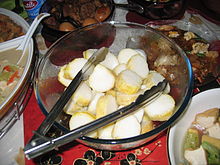
Lontong, popular in Indonesia and Malaysia, made of compressed rice rolled into a banana leaf
Equally a nutrient staple [edit]
In Republic of indonesia rice cakes can exist manifestly and bland tasting, and are often treated as a food staple, as an alternative to steamed rice.
- Burasa, a type of rice dumpling cooked with coconut milk packed inside a banana leaf pouch. It is a delicacy of the Bugis and Makassar people of S Sulawesi, Indonesia, and often consumed equally a staple to replace steamed rice or ketupat. It is like to lontong, but with richer flavour acquired from coconut milk.
- Ketupat, or packed rice is a blazon of rice dumpling of Indonesia. Also can be found in Brunei, Malaysia, and Singapore. It is made from rice that has been wrapped in a Rhombus or kite shaped woven palm leafage pouch and boiled. Equally the rice cooks, the grains expand to fill up the pouch and the rice becomes compressed. This method of cooking gives the ketupat its characteristic form and texture of a rice dumpling. Ketupat is commonly eaten with rendang or served as an accompaniment to satay or gado-gado. Ketupat is also traditionally served by Malays at open houses on festive occasions such as Idul Fitri (Hari Raya Aidilfitri). During Idul Fitri in Indonesia, ketupat is frequently served with opor ayam (chicken in coconut milk), accompanied with spicy soy pulverisation.
- Lontong, popular in Indonesia and also can be constitute in Malaysia, is fabricated of compressed rice that is then cut into small cakes. It is traditionally made past boiling the rice until it is partially cooked and packing it tightly into a rolled-upwardly assistant leaf. The leafage is secured and cooked in boiling water for almost 90 minutes. One time the compacted rice has cooled, it can be cut upwardly into bite-sized pieces. The dish is usually served common cold or at room temperature with sauce-based dishes such as gado-gado and salads, although it can be eaten as an accompaniment to other dishes such as Satay and curries.
- Nasi himpit, can be found in Indonesia and Malaysia. Unlike ketupat or lontong, nasi himpit is not cooked in a wrapping. Instead, the already boiled or steamed rice is pounded in a mortar into paste which is and so molded and cut into a cube before eating. It is ofttimes eaten with Sayur lodeh or Soto.
As a snack [edit]

Kue lapis, multi-layered colorful sweet glutinous rice block
Numerous types of Indonesian kue (traditional cake) are made using glutinous rice or rice flour. They tin be sweet or savoury. Varieties include:
- Arem-arem, a smaller lontong filled with vegetables and meat.
- Klepon, balls of gummy rice flour filled with gula jawa (cerise palm sugar) and boiled or steamed. Afterwards the balls are rolled in grated coconut. In Sumatra and the Malay Peninsula, they are called "onde-onde".
- Kue lapis, a layered colorful cake made of glutinous rice flour, coconut and sugar.
- Lemper, a savoury snack made of pasty rice filled with chicken, fish or abon (meat floss). The meat filling is rolled inside the rice in a fashion very similar to Chinese zongzi. A variant of lemper which instead of existence wrapped with a banana leafage is wrapped inside of a thin egg omelette is called semar mendem.
- Lepet, a sticky rice dumpling mixed with peanuts cooked with kokosnoot milk and packed inside janur (young coconut foliage or palm leaf). It is a delicacy commonly constitute in Javanese and Sundanese cuisine and often consumed equally snack.
- Lupis, compressed viscid rice served with grated coconut and kokosnoot sugar syrup.
- Nagasari or kue pisang, a traditional steamed block made from rice flour, coconut milk and sugar and filled with slices of banana.[20]
- Putu, green pandan-colored rice flour filled with kokosnoot carbohydrate and steamed in bamboo cylinder.
- Serabi, a type of pancake made from rice flour with kokosnoot milk or just plain shredded kokosnoot as an emulsifier.
Japanese [edit]
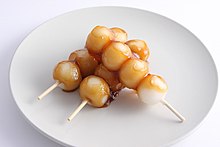
Dango, a Japanese dumpling fabricated from rice-flour
- Mochi is made of glutinous rice pounded into paste and molded into shape. In Nihon it is traditionally made in a anniversary called mochitsuki. While also eaten year-round, mochi is a traditional food for the Japanese New year and is ordinarily sold and eaten during that fourth dimension.
- Senbei are a blazon of Japanese rice crackers, ordinarily cooked by beingness broiled or grilled, traditionally over charcoal. While being prepared they may be brushed with a flavoring sauce, oftentimes i made of soy sauce and mirin. They may then be wrapped with a layer of nori. Alternatively they may exist flavored with salt or and so-chosen "salad" flavoring.
- Dango are a form of rice-flour dumpling frequently served on a skewer and with many unlike flavors eaten traditionally during different seasons.
Korean [edit]
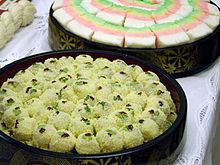
Steamed rice cake in an earthenware steamer was the oldest principal nutrient for Koreans before sticky rice took over upon the invention of the iron pot.[21] At present, there are hundreds of different kinds of Korean rice cake or "tteok" eaten year circular. In Korea, information technology is customary to eat tteok guk (tteok soup) on New year's day and sweet tteok at weddings and on birthdays. It is often considered a celebratory nutrient and can range from rather elaborate versions or down to the plain-flavored tteok. Rice cakes are chosen for item occasions depending on their color and the role they play in Korea's traditional yin-yang cosmology.[22]
- Tteok is a grade of Korean cakes mostly fabricated with viscid rice flour (also known as sweetness rice or chapssal). Tteok is unremarkably divided into iv categories: "Steamed tteok" (찌는 떡, 甑餠), "Pounded tteok" (치는 떡, 搗餠), "Boiled tteok" (삶는 떡 搗餠) and "Pan-fried tteok" (지지는 떡 油煎餠).
- Sirutteok is one kind of steamed tteok made from rice (맵쌀, maepssal in Korean) or glutinous rice (찹쌀 chapssal) which are sometimes mixed together with other grains, beans (azuki beans or mung beans), sesame seeds, wheat flour, or starch. Fruits and basics are used every bit subsidiary ingredients.
- Injeolmi is an example of pounded tteok. The traditional grooming for pounded tteok is fabricated by pounding rice or glutinous rice with utensils chosen jeolgu and jeolgutgongi or tteokme and anban. Injeolmi (tteok coated with edible bean powder), garaetteok (가래떡 cylinder-shaped white tteok), jeolpyeon (절편 patterned tteok) and danja (단자 viscid tteok ball coated with bean paste)" are ordinarily eaten pounded tteok.
- Songpyeon and Bupyeon are rice cakes which take been molded into shape. There are dozens of these kinds of cakes in Korea. Some consist of gluey rice flour dough and a sweetness filling covered with gomul, a kind of powdered beans.[23]
- Kkultteok (꿀떡, (lit. 'honey tteok') is made past mixing honey with glutinous rice powder and sieving it with chestnuts, jujubes, pine nuts, etc.[24] Kkul tteok is similar to songpyeon in shape, but smaller in size.
- Hwajeon [25] are small sugariness pancakes fabricated of sticky rice flour and flower petals from seasonal blooms, such as the Korean azalea, chrysanthemum, or rose.
- Tteokbokki is a stir-fried dish fabricated with garaetteok and commonly sold past street vendors. Information technology is unremarkably seasoned with gochujang (chili paste) only can also be served with a sauce based on soy sauce and commonly contains fish cake, boiled eggs, and green onion.
- Tteokguk is a soup that is eaten in Seollal. It contains such ingredients as sliced tteok, anchovy, dark-green onion, and eggs.
- Mujigae-tteok or 'rainbow rice cake' is a layered tteok of unlike colors resembling a rainbow. Colors are typically low-cal blood-red, yellow, and green.[26]
Sri Lankan [edit]
- Idli, originating in South Bharat, it is a savoury rice cake that is popularly eaten for breakfast.
- Puttu, originating in S India, information technology is widely consumed throughout the land. Information technology is a cylinder made out of steamed ground rice and coconut.
- Seenakku, a rice cake fabricated out of mucilaginous rice and served with grated kokosnoot, it derives from the Chinese nian gao.
Taiwanese [edit]
- Tainan bowl rice cake (óaⁿ-kóe, 碗粿) has its origins in the southern Taiwanese city of Tainan. The dish is made by steaming sticky rice once, then putting toppings in it and steaming it again.
Vietnamese [edit]
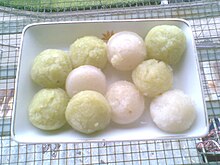
Steamed Bánh bò, a sweet, chewy Vietnamese sponge cake made from rice flour
- Bánh bèo is a variety of small steamed rice cake or rice pancake typically featuring a dimple in the center, which is filled with savory ingredients including chopped dried or fresh shrimp, scallions, mung edible bean paste, crispy fried shallots, fish sauce, rice vinegar, and oil.
- Bánh bò is a sweet, chewy sponge cake made from rice flour, water, sugar, and yeast.
- Bánh đúc is a cake made from non-gummy rice flour (although corn flour is also used in northern Vietnam). In the north it is typically garnished with savory ingredients such as ground pork, tôm chấy (grilled ground shrimp), fried onions, sesame seeds, salt, peanuts, lime juice, and soy sauce or fish sauce. In the south, it is served every bit a dessert, and takes the form of gelatinous blocks that are often colored green by the add-on of Pandanus amaryllifolius foliage extract. Information technology is cooked by humid the ingredients and allowing them to cool, solidifying into a jelly-like canvas that is then cutting into blocks.
- Bánh chưng is fabricated from glutinous rice, mung bean, pork and other ingredients. Bánh tét is much the aforementioned but cut in a circular grade, and consumed in celebration of the Vietnamese holiday Tết.
- Bánh tổ is a rice cake made out of glutinous rice and is related to the Chinese nian gao.
In other cuisines [edit]
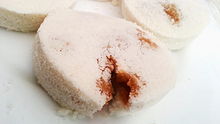
- Chwee kueh, (lit. 'h2o rice block') is a type of steamed rice cake, a cuisine of Singapore and Johor. It is made by mixing rice flour and h2o to course a slightly viscous mixture, which is then placed in small cup-shaped containers that look like saucers and steamed, forming a characteristic basin-similar shape when cooked. The rice cakes are topped with diced preserved radish and served with chilli sauce. Chwee kueh is a popular breakfast item in Singapore and Johor.
- Puffed rice cakes, popular in North America and other Western countries, are made with puffed rice, a puffed grain usually created by heating rice kernels nether high pressure in the presence of steam, though the method of industry varies widely. The puffed grains are then bonded together by a wide diversity of methods in the form of a cake. They are popular amidst immature children and amid health-conscious people as a lower calorie substitute for breadstuff, crackers, or chips. They may be plain, salted, flavored or half coated in chocolate or yogurt.
- Rijsttaart and Rijstevlaai in Dutch and Belgian cuisine are kinds of rice pie, with the filling of mixed rice, sugar, eggs and milk.
- In Italian cuisine, specifically the cuisine of Tuscany, torte di riso are rice cakes sometimes eaten as a substantial dessert at the cease of a meal.
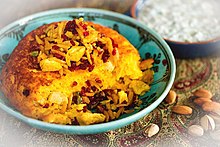
- In Iranian cuisine, Tahchin or Western farsi baked rice cake is a type of steamed rice block fabricated with yogurt, saffron, eggs, and craven fillets.
- In Nigerian Cuisine, Masa is a rice cake similar to a pan fried rice cake in an oval shape eaten with different stews, and is from the Northern Region particularly the Hausa ethnic group.
- Vitumbua is a coastal East- African Swahili dish fabricated of rice or rice flour and kokosnoot eaten mostly for breakfast.
See also [edit]
- List of rice dishes
- List of steamed foods
- chimaki
- ohagi
- Zongzi
References [edit]
- ^ Bush, Austin. "10 foods to try in Myanmar -- from tea leaf salad to Shan-fashion rice". CNN . Retrieved 2020-05-31 .
- ^ "Burmese sweets". Austin Bush . Retrieved 2021-01-08 .
- ^ Thompson, Nathan A. "Cambodian Ghosts Love Sticky Rice Cakes". Vice . Retrieved 23 September 2017.
- ^ "Swallow and Nham PP". weebly . Retrieved 23 September 2017.
- ^ Dosaikal (9 September 2013). "Num Kom-Viscid Rice Cakes with coconut filling/Central khmer Kozhukkattai!". Dosaikal.com . Retrieved 23 September 2017.
- ^ Srey, Nit. "Deep in Idea in Philosopher'south Lane". Khmer Times . Retrieved 23 September 2017.
- ^ "Accurate CAMBODIAN – BAIH Khmer". Junction Mag. Archived from the original on 13 Apr 2017. Retrieved 23 September 2017.
- ^ Sak, Chan Nita. "Eat and Nham PP". Weebly . Retrieved 23 September 2017.
- ^ Dosaikal (xx March 2015). "Khmer Memories – Num Plae Ai/Sticky Rice Sweet Assurance". Dosaikal.com . Retrieved 23 September 2017.
- ^ "Nom Plai Ai (pasty rice assurance filled w/palm carbohydrate)". Eat At present Cry Later . Retrieved 23 September 2017.
- ^ Seang, Leakhena. "Consume and Nham PP". Weebly . Retrieved 23 September 2017.
- ^ Pen, Dara. "Eat and Nham PP". Weebly . Retrieved 23 September 2017.
- ^ Yeun, Petra. "Cambodia Dessert and Snack". blogspot.com . Retrieved 23 September 2017.
- ^ "米糕" (in Chinese).
- ^ "西安甑糕,一份值得耐心等待的软糯香甜" (in Chinese).
- ^ "MoonFestival - Foods".
- ^ Nocheseda, Elmer. "The Invention of Happiness". Manila Speak . Retrieved 8 Dec 2018.
- ^ Dizon, Erika. "Ever Wonder Why Puto Bumbong Is Violet? (It's Not Ube)". Spot.ph . Retrieved 23 April 2019.
- ^ Pereira Kamat, Melinda (16 August 2008), "A tradition wrapped in leaves", The Times of Republic of india, Goa, archived from the original on 9 October 2018, retrieved 16 August 2017
- ^ Kong Foong Ling (2012). "Kue Nagasari". The Food of Asia: Featuring Authentic Recipes from Master Chefs. Tuttle Publishing. p. 328. ISBN9781462909728.
- ^ ko:떡
- ^ "Official Site of Korea Tourism Org.: 'Rice Cake, Tteok :The Official Korea Tourism Guide Site". Retrieved 11 November 2012.
- ^ "경남도민일보 ::: 밀양떡, 양반 입맛 사로잡던 그 맛 그대로". Odomin.com. 10 Apr 2008. Retrieved 2012-09-03 .
- ^ "꿀떡".
- ^ "화전". Lifeinkorea.com. Retrieved 2012-09-03 .
- ^ "Korean - English dictionary - View Lexicon". krdict.korean.become.kr . Retrieved 2019-03-19 .
Source: https://en.wikipedia.org/wiki/Rice_cake
Posted by: jordanemptiou.blogspot.com
0 Response to "Which Of These Is Considered A Rice Cake"
Post a Comment